2023
Network-Attached Polarized Landscape aims to re-construct a space that was temporarily adopted by analysing its physical and environmental factors. Here, space is understood not only as what exists on the surface, but also as a whole that contains all interactions within that space. This proposal expresses the fact that the space is a constantly changing structure and that these changes are connected to perceptual experiences. Within this framework, transformations undergone during the process of working on the borders and potentials of the space are treated as the problematics of this construct.
In the early phases of the work that began as a space-based research, the aim was to remove the existing surface and discover the voids beneath the surface, the movement caused by these voids and the interaction between traces left behind by movement. However, changes, setbacks and related ambiguities led to a deviation in the course of the structure: the transformed context paved the way for the structure to be researched in a series of new spaces, different materials and alternative forms of presentation.
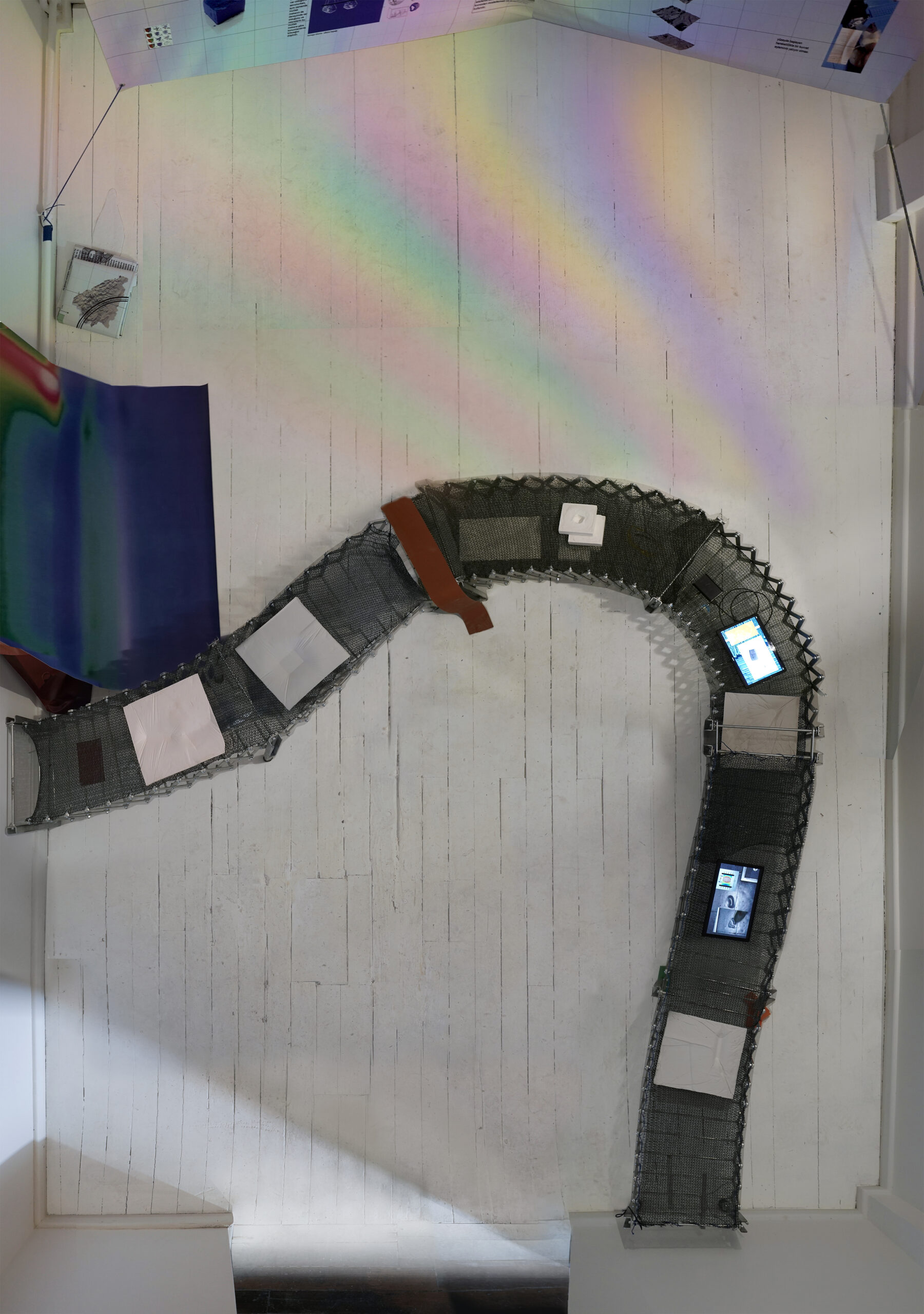
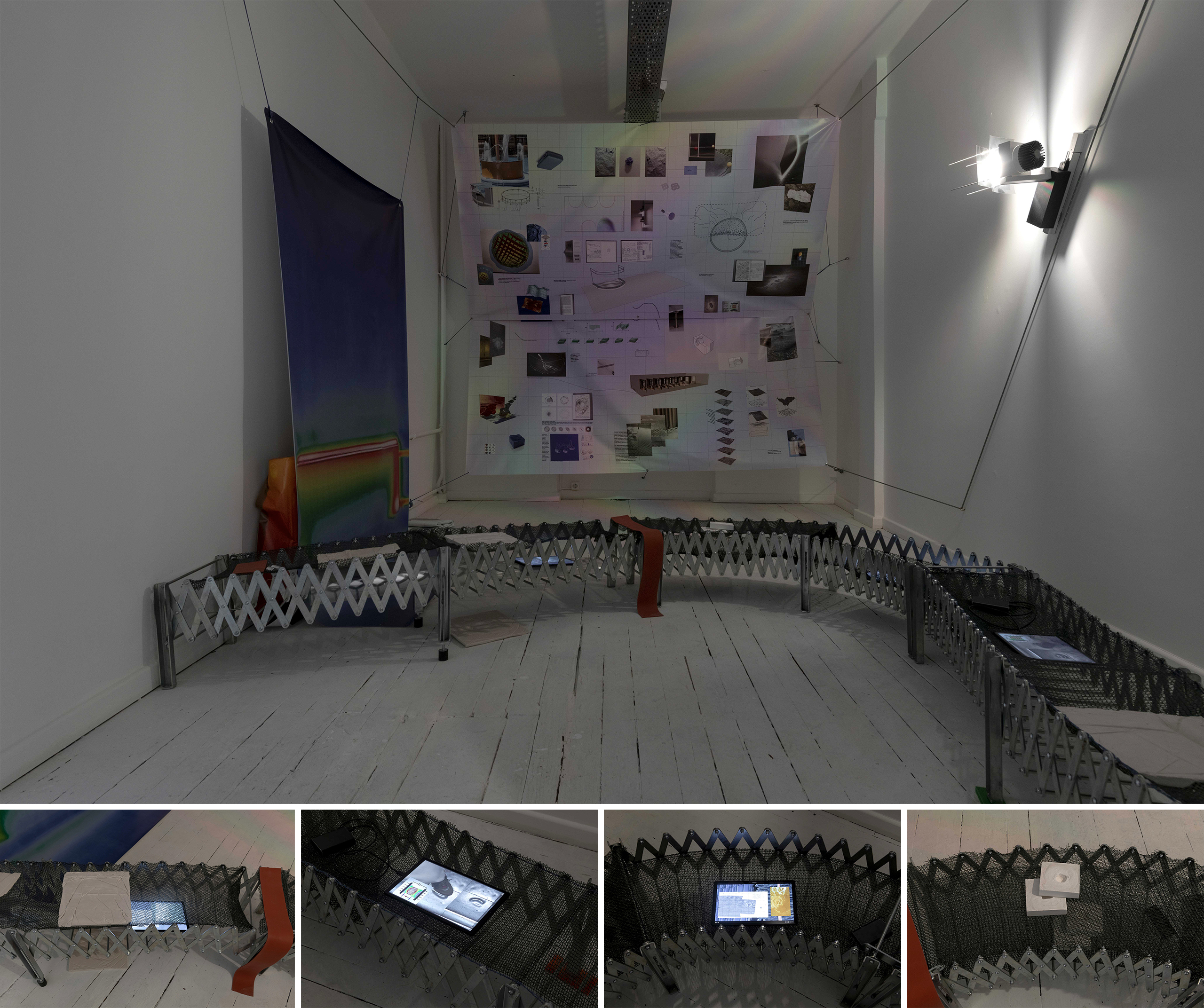
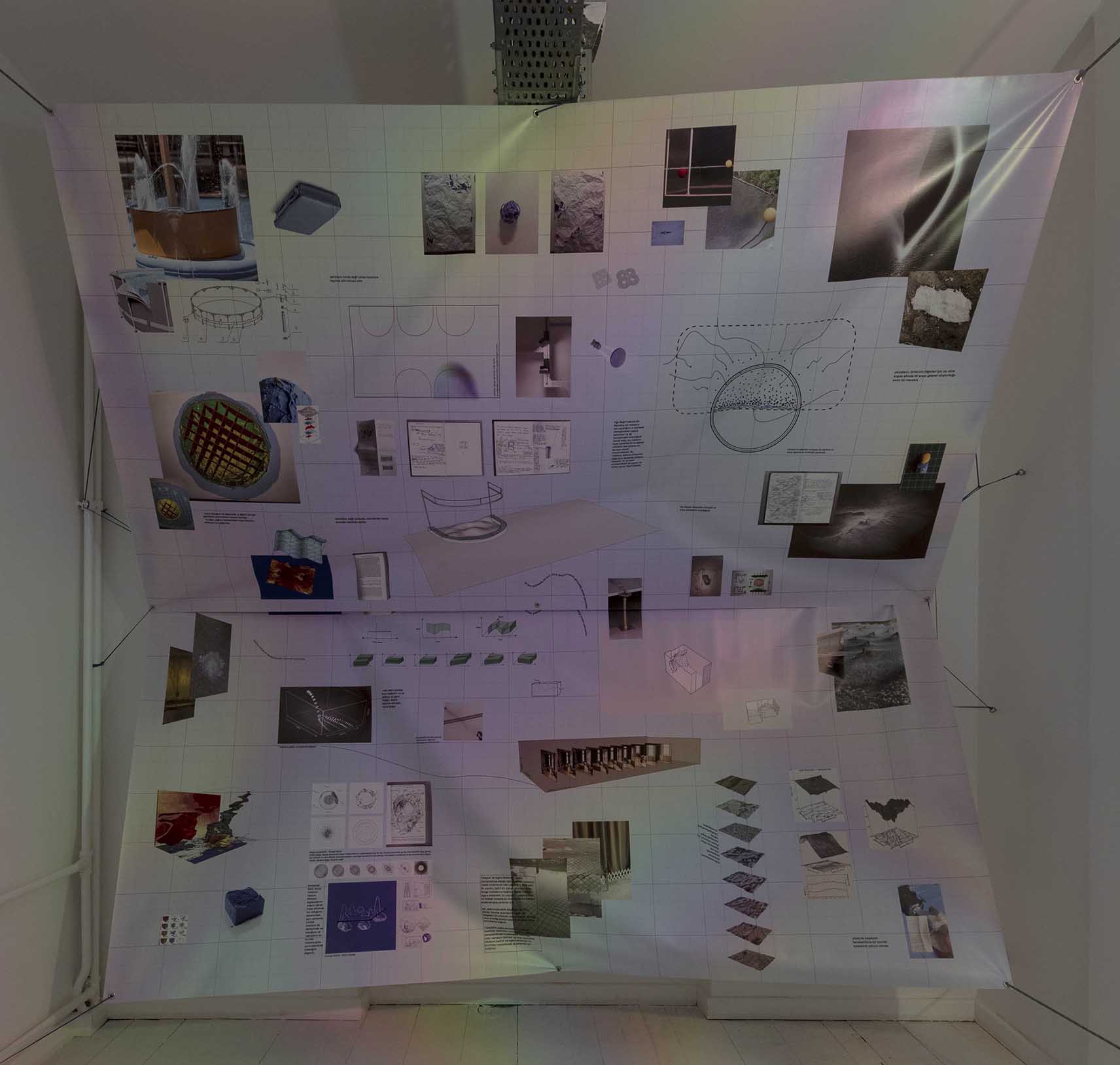
The work seeks to deal with these potentials in an open-ended manner, evolving towards a format that can adapt itself to different fields. The elevated extendable conveyor that allows for an amorphous installation, enables the discovery of the new possibilities of the present surface and an experience of the fields of interaction in the space. In this context, the mapping study, which is part of the installation, transforms into a type of landscape, suspended in mid-air, visualizing the complexity and environmental interactions of spaces via grid systems and network simulations.
–
Network-Attached Polarized Landscape is a modular installation developed over a six-month production period at SAHA Studio. The work is composed of a carrier conveyor system spanned by a fishing net, digital screens and power-transfer units positioned on this net, and plaster surface molds, together forming a spatial unit that spreads through and partitions the exhibition space.
The fishing net stretched across the conveyor surface functions as the primary load-bearing structure. Tablets placed at different points on the net display looped video recordings, while the power banks that supply them and the plaster surface molds, through their weight and positioning, generate localized fields of attraction on the net, producing a stabilized distribution across the conveyor.
On another wall of the space, a stretched tarpaulin surface carries notes, drawings, reference images, and quotations related to displacement, bending/folding, and elasticity. This tarpaulin makes visible the installation’s processual dimension and its investigation into the physical behavior of materials.
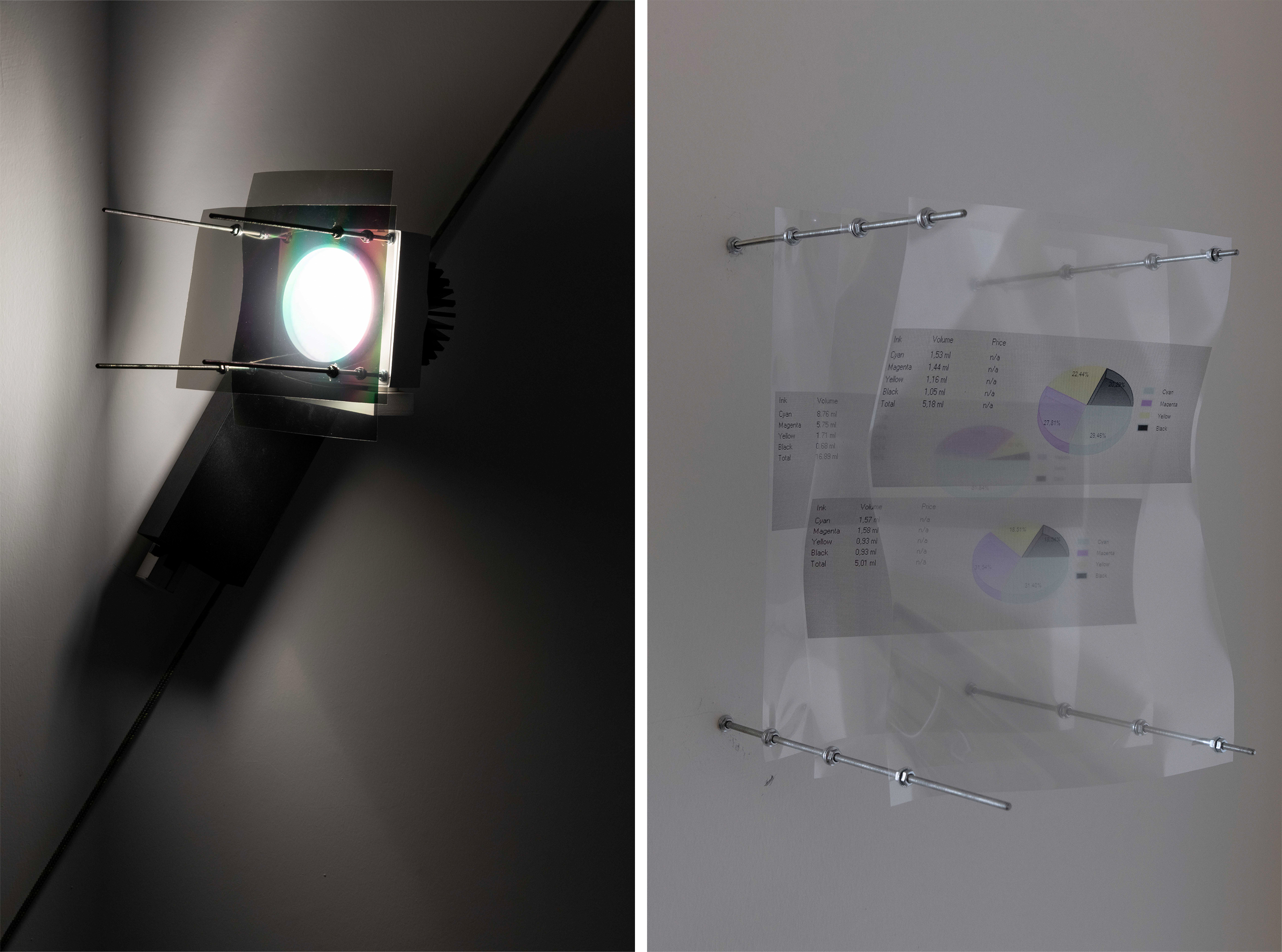
A polarization filter positioned at an oblique angle to the light source intervenes in the light’s wavelength, rendering the color separations within the light visible and structuring the overall illumination of the space through this spectral refraction. On the exit wall of the installation, a printed acetate sheet functions as a diagram, showing the proportional distribution of the color components of the graphic and text-based images printed on the tarpaulin.